Story of St Edmund
Saint Edmund was a ninth-century king of East Anglia and England’s first patron saint, eventually being replaced by Saint George in the mid-fifteenth century. For centuries, his life and martyrdom played a key role in shaping Bury St Edmunds as a centre of pilgrimage and spiritual importance.
Edmund became king around 855 AD, when he was still a teenager. His rule coincided with a turbulent period in English history, marked by the growing threat of Viking invasions. In 869 AD Viking forces, known as the Great Heathen Army, invaded East Anglia. According to tradition, Edmund was captured and, after refusing to renounce his Christian faith or submit to pagan rule, the Vikings tied him to a tree, shot him with arrows and beheaded him. A popular cult began soon after his death and he was canonised as a saint.
Legend tells us that Edmund’s body was left in the woods and that the Vikings threw his severed head into a thicket to prevent a proper Christian burial. His followers searched for him for some time before they heard a strange sound, a voice crying out “here, here, here!” Following the noise through the forest, they discovered a wolf guarding Edmund’s head. Miraculously, the wolf was not acting aggressively but was gently cradling the head between its paws, as if protecting it. The men approached, expecting the wolf to flee or attack. Instead, it calmly allowed them to take the head and return it to the body. When Edmund’s head was reunited with his body, it was said to have fused back together, leaving only a faint red line. This was considered a miracle, and soon after he was venerated as a saint.
In 903 AD Edmund’s body was brought to Beodricsworth (now Bury St Edmunds). In 1020 AD King Cnut founded a Benedictine monastery – the Abbey of Saint Edmund – and built a stone church, a rotunda, to house a shrine containing Edmund’s remains. Over five hundred years later, during the Dissolution of the Monasteries (when Henry VIII confiscated their lands and wealth), Edmund’s remains were reportedly spirited away. Their location remains a mystery. Some believe they were hidden, others claim they were taken to France.
Today, Saint Edmund is a central figure in the town’s identity. His legacy lives on in the name of St Edmundsbury Cathedral, in the ruins of the great Abbey, and in the continued reverence of him as the patron saint of Suffolk.
History of the Abbey
Medieval Period
The Abbey of St Edmund quickly became one of the richest and most powerful monasteries in medieval England. For hundreds of years, pilgrims flocked to visit Edmund’s shrine, which was lavishly decorated and known throughout Europe. The Abbey Church became one of the largest in England, and the surrounding town prospered from the steady flow of visitors. In 1214 the Barons of England met in secret here and swore to force King John to accept a charter which became Magna Carta.
16th Century
In 1539, during the Dissolution of the Monasteries under King Henry VIII, the Abbey of St Edmund was officially closed. The monks were expelled, the shrine of Saint Edmund was dismantled, and the Abbey’s vast wealth was seized by the Crown.
Over the next few decades, the Abbey buildings were largely demolished and stripped of valuable materials. Lead from the roofs and high-quality limestone from the walls were removed and sold off or repurposed for local buildings. It’s library of about 100 books was broken up. The once-glorious Abbey Church, which had housed the shrine of Saint Edmund and was larger than nearby Ely Cathedral, fell into ruin. St James’s and St Mary’s remained local churches.
17th and 18th Centuries
Houses were built into the arches and towers of the ruined West Front in the 17th century and remain there today. The Abbey Precinct came under the control of various local landowners, most notably the Davers family who used it as a large garden to their town house on Angel Hill. It was later passed down to Frederick, Marquis of Bristol who also owned the nearby Ickworth Estate.
Some of the gatehouses, like the Abbot’s Bridge and Great Gate (now known as the Abbey Gate), survived and were reused. The Norman Tower, which had served as the bell tower for the Abbey Church, continued in use as the bell tower for St James’s Church (now St Edmundsbury Cathedral).
19th Century
Efforts were made to open the Abbey grounds to the public. In 1831, the Abbey Gardens were formally laid out and made accessible, turning the former monastic site into a landscaped park. Nathaniel Hodson’s original vision was a botanic garden laid out in the same style as the Royal Botanic Gardens in Brussels. Victorian interest in medieval history and ruins helped foster appreciation for the remaining structures and the area continued to be leased from Lord Bristol.
20th Century
In 1914, the Diocese of St Edmundsbury and Ipswich was created and St James’s Church, which was founded by Abbot Anselm, was elevated to cathedral status, becoming St Edmundsbury Cathedral. Throughout the 20th century, restoration and construction efforts improved the Cathedral, including the addition of the Millennium Tower, completed in 2005, reviving the skyline once dominated by the Abbey Church.
The Abbey Gardens were purchased by the Borough Council (now West Suffolk Council) in 1953 and remains in their care. In 1955, the area of the Abbey ruins was placed in the care of the Ministry of Public Works, which is now known as English Heritage.
21st Century
Today, the Abbey Gardens are a central part of Bury St Edmunds’ identity, attracting a million visits each year. The ruins are preserved as a scheduled monument and remain a powerful symbol of the town’s religious and historical heritage.
Abbey Area
The Abbey area incorporates many distinct and important features. At the heart of the historic Abbey site are the Abbey ruins and St Edmundsbury Cathedral with its associated buildings. To the south are the Great Churchyard and St Mary’s Church. The whole area is enclosed by the medieval precinct walls, with many historic, listed buildings along the street frontage.
Further south and to the east are the rare chalk stream rivers of the Lark and the Linnet. Across these lie the water meadows known as the Crankles and No Man’s Land. In medieval times, this is where some of the Abbey’s vineyards and fishponds were located.
St Edmundsbury Cathedral
St Edmundsbury Cathedral’s foundations date back to the beginnings of the Abbey when St Denys’s church was built on the Abbey site. In the early 12th century, Abbot Anselm rebuilt St Denys’s and dedicated the new church to Saint James. St James’s Church was largely rebuilt again in 1503 by John Wastell, the Abbey’s master mason who also worked on the chapel at Kings College in Cambridge. A Victorian restoration followed from 1860 with Sir Gilbert Scott at the helm, adding a new chancel and pitched Nave roof.
In 1914, St James’s Church became Suffolk’s Cathedral and in 1943 Stephen Dykes Bower was appointed as Architect. He continued the Gothic style of the medieval period and added a west porch, cloisters, quire, the Lady Chapel and St Edmund Chapel. A bequeathal from Dykes Bower upon his death in 1994 combined with a grant from the Millennium Commission to enable the North Transept to be added and the magnificent Millennium Tower, which was finished in 2005. The Chapel of the Transfiguration, the Crypt and Cloisters were added in 2009. The Abbey of St Edmund, Reborn project will help towards completing Dykes Bower’s vision by creating a West Cloister. You can find out more about that here.
A sculpture by Elizabeth Fink entitled Crucifixion stands by the Treasury steps. The medieval Susanna Window contains Flemish glass and the West Window depicts The Last Judgement – a magnificent example of late nineteenth-century craftsmanship. A painting of The Martrydom of St Edmund by Brian Whelan sits in the Lady Chapel. The Ancient Library, founded in 1595, has over 550 books mainly dating from the fifteenth and sixteenth centuries; three further libraries contain over 8,000 volumes, and most are available for borrowing.
Archaeology
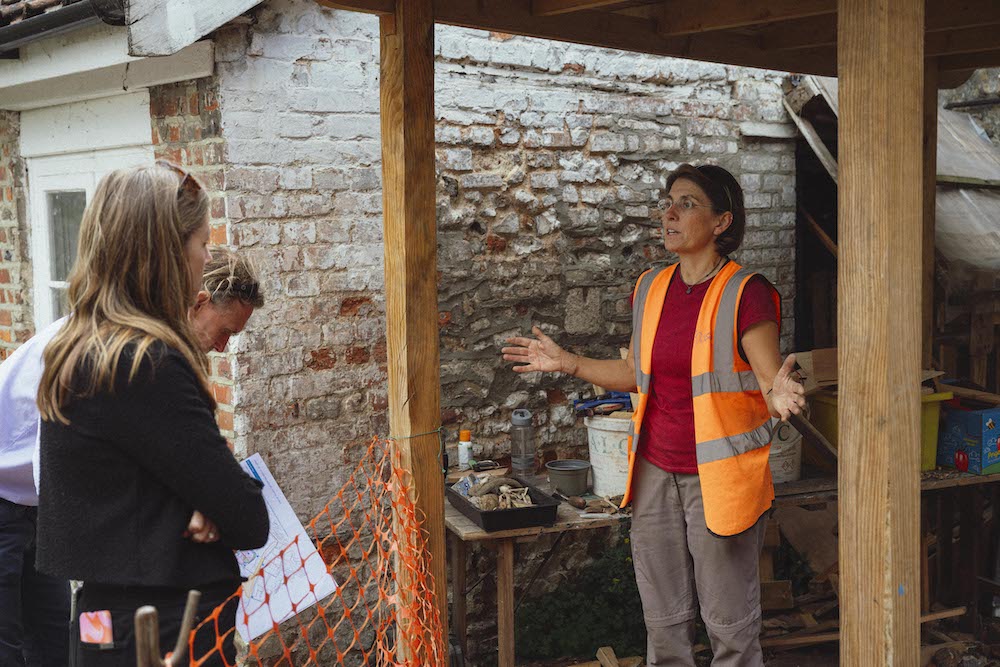
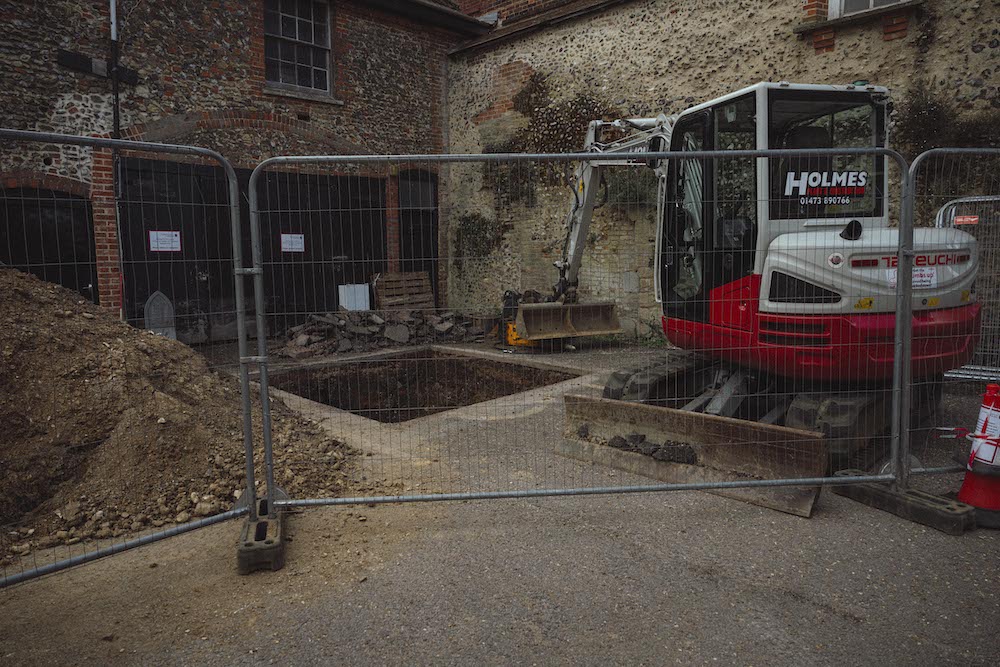
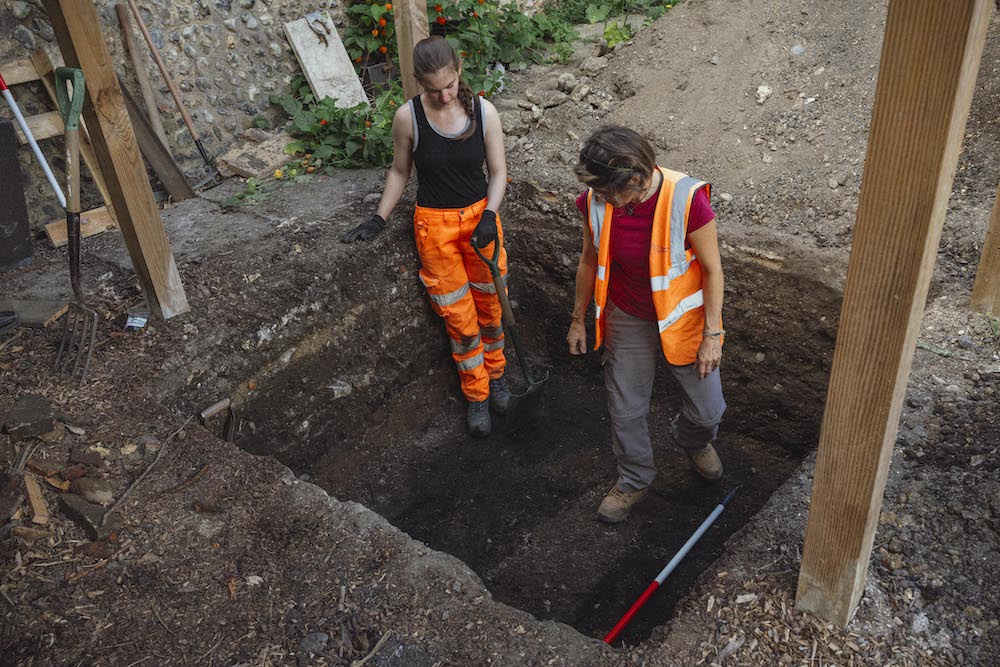
Before construction begins, an archaeological evaluation has to take place to see what impact the project may have on existing archaeological remains. This evaluation took place in August 2025. Two trenches in and around the Anselm Building were opened at a size of two to three metres square. These explorations help us to uncover evidence of the long history of the site and improve our understanding.
Findings from the evaluation are below:
- Geotechnical surveys recorded depth and profile of Anselm building and Precinct wall foundations. Window sampling to 4m depth recorded soil, water, moisture, gas and contamination conditions.
- Archaeological surveys evaluated two small trenches north and south of the Anselm building. Small finds dating from C17, including pins, tabaco pipes and animal bones. A significant find was the original monastic ground level and ‘suggested’ boundary ditch, parallel to the Precinct Wall.
- Additional archaeological surveys within the Abbey ruin area confirms very shallow building remains at around 7cm below ground level in three of the five test pits along the route of the proposed path network.
Recommendations from each survey will guide the design of a suitable building foundation and path design, based on the investigations final findings reports and Historic England’s guidance.